
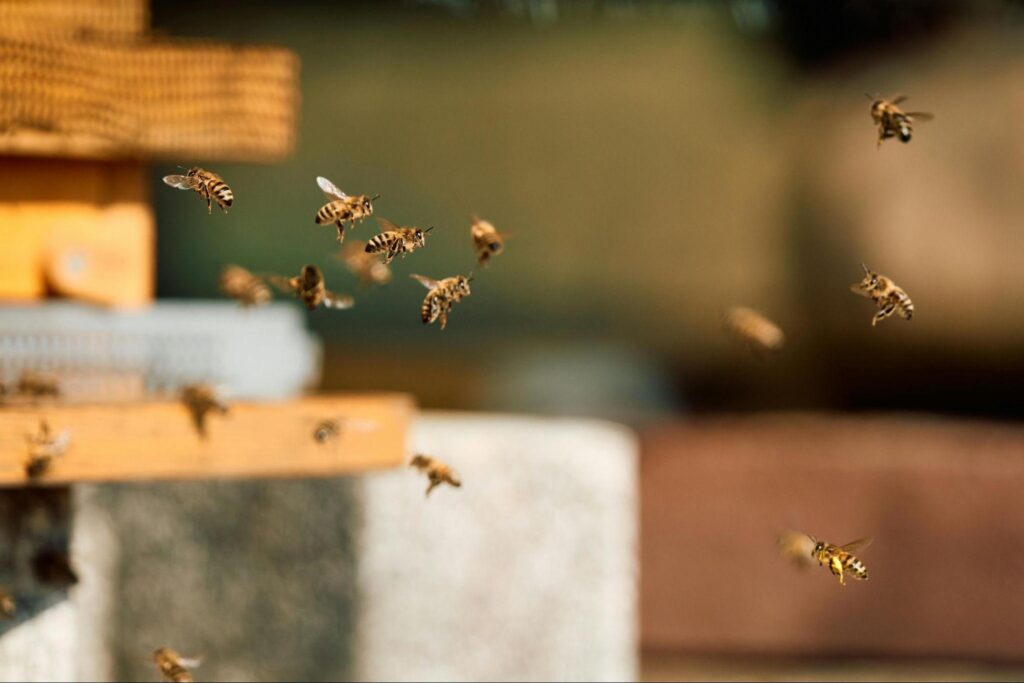
In tropical urban environments, bees are active year-round and frequently colonise commercial properties, drawn by sheltered spaces, accessible water sources, and nearby greenery. This persistent pressure means facilities managers need to know how to get rid of them in a way that is safe for occupants, compliant with national guidance, and unlikely to recur.
A colony near a production line, loading dock, or guest area creates compliance, safety, and operational risks, but the right response isn’t the same in every case. Species, hive location, and site conditions all determine the appropriate removal approach.
In Singapore, NParks and NEA prioritise public safety in bee-hive removals while minimising ecological impact on pollinators. While bees aren’t formally protected under local wildlife legislation, following their guidance meets the audit-ready standards most regulated facilities require. Choosing the right approach, however, starts with knowing what you’re dealing with.
Common Types of Bees in Singapore
With over 130 bee species documented by AVS, commercial risk typically centres on three specific categories.
1. Honey Bees (Giant, Dwarf, and Asian)
Apis honey bees are among the most commonly encountered bee species.
- Where They Nest: The Asian Honey Bee (Apis cerana) nests in sheltered cavities, including roof eaves and wall vents. The Giant Honey Bee (Apis dorsata) builds large, exposed combs on overhanging surfaces such as rooftop overhangs and external plant room housings. Dwarf honey bee species nest on single combs in vegetation and tend to favour sites near parks or green corridors.
- Behavioural Risk: Asian Honey Bees are defensive when their hive is threatened, but docile when foraging away from the nest. Giant Honey Bees are more reactive to disturbance than their smaller relatives. Dwarf honey bee species are migratory and often relocate their nests when conditions change.
- Operational Impact: Asian Honey Bees establish large colonies rapidly in hidden cavities; Giant Honey Bees nesting at height add working-at-height complexity; and Dwarf Honey Bees are migratory species and may return to the same sites if access points aren’t sealed after removal.
2. Carpenter Bees and Solitary Species
Unlike social bees, Carpenter bees are solitary but cause cumulative structural degradation.
- Where They Nest: Untreated or unpainted timber is the primary target: wooden pallets, racking, signage, and external timber elements. They are common in warehousing and logistics environments where timber cycles through frequently.
- Behavioural Risk: Carpenter bees (Xylocopa spp.) bore circular entry tunnels approximately 13mm in diameter into untreated timber surfaces. They nest independently rather than in colonies and are not aggressive unless directly handled.
- Operational Impact: Repeated boring weakens load-bearing timber and creates moisture ingress over time, damage that’s easy to underestimate because individual holes appear minor.
3. Sweat Bees
Sweat Bees are among the smallest and least aggressive bees.
- Where They Nest: Soil and ground‑level crevices near lawns or open ground. They favour warm, undisturbed ground close to human activity.
- Behavioural Risk: Sweat bees (Lasioglossum spp.) are attracted to human perspiration, which they land on skin to drink. They are primarily solitary or weakly social, do not form large colonies, and have a low sting risk.
- Operational Impact: Nuisance rather than direct property risk under most circumstances. Any presence in food-handling or guest-facing areas should be documented and assessed under the facility’s pest management programme.
Identifying Vulnerabilities: Signs of Bee Infestations
Early identification is the primary defence against operational disruption. A bee infestation caught before it’s fully established is faster to resolve and less disruptive than one discovered during an audit or following a complaint.
Signs to look for during routine site inspections:
- Flight Path Consistency: Consistent bee activity around the same point on the building envelope, particularly near roof eaves, ventilation openings, or cladding joints. Visible hive or comb on exterior surfaces, under overhangs, or within plant room housings.
- Acoustic Indicators: Persistent buzzing from within a wall, ceiling void, or enclosed space.
- Structural Anomalies: Circular bore holes in unpainted or untreated timber, approximately 13mm in diameter. Honeycomb residue or wax deposits around construction joints or cladding gaps.
In food processing and F&B operations, any bee presence near production, packaging, or storage areas warrants immediate professional assessment.
What to Avoid When Dealing with Bees

In a commercial setting, an incorrect first response can escalate a minor issue into a major safety incident.
- Do not attempt DIY hive removal: Approaching an active colony without proper equipment risks provoking thousands of individuals simultaneously and could become a workplace safety incident, not a maintenance task.
- Do not apply commercial insecticides: Treating an active hive in a closed space with insecticide can push bees further into wall voids. This makes it harder for professionals to remove them and leaves a decaying mass inside the building’s structure.
- Avoid blocking hive entrances: This agitates the colony and can force bees into adjacent internal spaces, including production areas or occupied rooms.
- Do not use smoke or fire-based methods on commercial premises: These are ineffective removal strategies and carry fire safety implications in facilities.
- Do not ignore early sightings: A small cluster around a roof junction or ventilation opening often indicates scouting behaviour. Colonies establish quickly once a suitable site is confirmed.
Prevention Strategies for Commercial Facilities
Facilities that have the least recurring bee issues tackle the underlying physical and environmental conditions as part of their regular maintenance cycle, rather than reacting to an active problem.
1. Seal Entry Points
Regular inspection of the building’s exterior, such as walls, roof junctions, vents, and entry points, is the most reliable starting point. Bees can enter through small gaps such as deteriorating window sealant, open conduit runs, unprotected vents, roller door frame gaps, and old cladding joints.
For large warehouses and industrial properties, schedule routine inspections rather than waiting for an incident. Focus on external walls, roof junctions, utility penetrations, and recently modified sections, sealing any gaps with materials suited to the surface and location.
2. Reduce Attractants
Bees are attracted to food waste, pooled water from clogged drains or air conditioning runoff, and flowering plants near building walls. The smells from food and F&B operations can draw foragers from far away. For food processing and hospitality sites, managing these attractants naturally aligns with existing NEA and SFA waste and hygiene compliance. It is best to include bee prevention as part of an integrated pest management (IPM) programme instead of handling it as a separate issue.
3. Remove Honeycomb
If a colony relocates naturally or is professionally removed, all residual comb must be fully extracted. Comb left in wall voids or roof spaces emits odour signals that attract new colonies and draw secondary pests like rodents and cockroaches. Confirm this is included in the initial removal scope, not added as a separate task later.
Professional Bee Removal and Relocation
Where a colony is established, professional intervention is the appropriate course of action.
What’s the Fastest Way to Get Rid of Bees?
Professional relocation is both the fastest method and the most appropriate for commercial properties. A trained technician assesses the hive location, species, and access requirements before carrying out removal with minimal disruption to facility operations. The colony and comb are transferred to a managed environment, and the access point is treated to reduce the likelihood of re-colonisation.
Attempting to get rid of bees through improvised methods takes longer, carries a higher risk of agitating the colony, and rarely achieves complete removal.
What Keeps Bees Away?
Long-term control requires addressing the three conditions that make a site attractive: gaps in the building envelope, food and water sources in the facility perimeter, and the absence of regular monitoring. A one-time hive removal without attention to these factors typically results in recurring activity from the same site or adjacent locations.
Ongoing pest management programmes that include bee monitoring, scheduled envelope checks, and documented service records provide the most defensible position for facilities operating under regular audit scrutiny.
How to Get Rid of Bees in Singapore
PestBusters provides bee species identification, humane hive relocation, and post-removal monitoring across industrial, food processing, logistics, and hospitality facilities in Singapore. All work follows a relocation-first approach aligned with AVS guidance, is carried out by NEA-licensed technicians, and includes full service documentation for audit and compliance records.
It’s also important to check whether you suspect wasp activity rather than bee activity. Facilities managers should also be aware of how to remove a wasp nest safely. Bees and wasps are distinct species with different nesting habits, colony behaviours, and removal requirements, so correct identification before any intervention matters.
Why Professional Removal Matters for Commercial Operations
An active bee colony on a commercial site creates three operational risks that extend well beyond the immediate safety concern.
- Personnel safety: Bee stings can trigger anaphylactic reactions, which are classified as medical emergencies. In a busy warehouse, food processing plant, or logistics hub, a provoked swarm event disrupts operations and generates a workplace safety incident requiring formal documentation under the Workplace Safety and Health Act.
- Compliance exposure: Food processing and F&B facilities operating under SFA licensing and NEA oversight must demonstrate documented pest management programmes. A bee colony present on-site without a recorded professional response constitutes a gap in that record, regardless of how quickly it is addressed upon discovery. For facilities that go through regular third-party audits, this kind of gap carries consequences that extend beyond the inspection itself.
- Reputational and client risk: For hospitality properties, a guest encounter with an active hive is an immediate reputation management issue. For logistics and supply chain operators, visible pest activity near stored inventory or loading areas raises contamination questions that can affect client relationships and contract discussions.
Professional removal, paired with documented service records, addresses all three. Unassisted or incomplete attempts typically resolve the visible hive but leave the underlying access points and attractant conditions unchanged.
Address Bee Risk Before It Affects Operations
Sooner or later, bees show up. What happens after that depends on your team. Preventive management costs less than reactive removal, and an unmanaged incident adds compliance work on top of that. Facilities that handle bee risk most effectively treat it as a standing item in their pest management programme, not a one-off response after a colony is already established.
Contact PestBusters to arrange a site assessment covering bee risk, humane removal, and preventive monitoring. Our Singapore pest control programmes are built to your facility’s compliance requirements, from initial assessment through to ongoing monitoring.